
Packed buses, crowded streets: Malta’s overtourism gets a social media page
Staff Reporter , Published: June 12, 2026, 11:06 pm
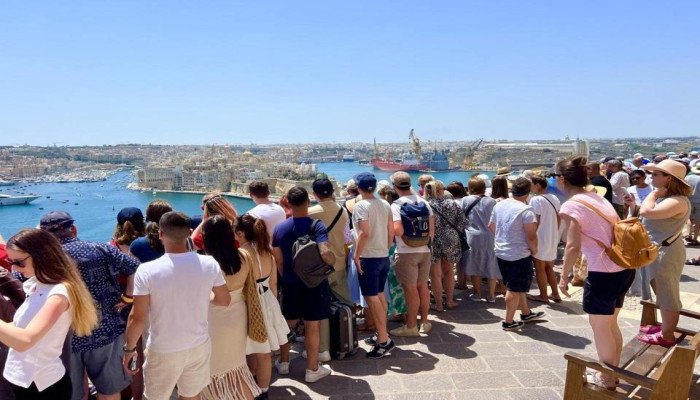
New Instagram Page Highlights Growing Concerns Over Overtourism in Malta
A new Instagram page campaigning against overtourism is drawing attention to a frustration shared by many Maltese residents: a walk through Valletta that once took five minutes can now take three times as long.
Launched three weeks ago by activist Michaela Pia Camilleri, Overtouristed Malta documents the daily realities of life on an island grappling with record tourist numbers. Through videos and photos, the page showcases overcrowded buses, overflowing bins, and packed public spaces.
“Trying to walk through the crowds on Republic Street, even in May, began to feel like I was in an obstacle course,” Camilleri said.
One of the page’s first reels captures the experience of walking through Valletta before the peak summer season. The video shows pedestrians weaving between tables and chairs along Merchants Street before encountering dense crowds on Republic Street heading towards the Triton Fountain. For many people who work in the capital, the scenes reflect an increasingly familiar daily experience.
Camilleri believes there has been a lack of organised activism addressing overtourism directly. While public debate often focuses on issues such as hotel development, short-term rentals and the occupation of public spaces by catering establishments, she argues that the wider impact of excessive tourism has not received enough attention.
As someone who regularly commutes through Floriana, she says she has witnessed firsthand the effects of cruise tourism on the locality’s ageing and declining population.
“The cruise ships make so much noise. Residents in Floriana complain about it, but there are so few residents left nowadays that their voices aren’t being heard. You end up feeling claustrophobic because you can’t escape the noise,” she said.
Camilleri emphasised that her concerns are not directed at tourism itself, but at the scale at which it is currently taking place.
“One of my main concerns is the large number of tourists when we consider Malta’s size. We are simply too small for these quantities,” she said.
According to the National Statistics Office, Malta welcomed more than four million inbound tourists in 2025, a 12.9% increase over the previous year. Tourist expenditure reached an estimated €3.9 billion, representing an 18.6% rise compared to 2024.
Camilleri believes Malta should establish a tourism carrying capacity to determine how many visitors the islands can realistically accommodate without compromising residents’ quality of life. She argues that the country should focus on attracting visitors interested in meaningful cultural engagement rather than quick, low-cost consumption.
“Tourists should truly engage with local people and communities, rather than treating them as products,” she said.
She also highlighted the impact of tourism on public services and housing. Increased demand, she argues, places pressure on public transport and ferry services, while the growth of short-term rentals has contributed to rising property prices.
“Floriana is a prime example. I would love to live there, but I can’t afford it anymore. So much of it has become Airbnbs,” she said, adding that the spread of short-let accommodation has weakened local communities.
‘Satisfying the Tourist Gaze’
Camilleri also links overtourism to Malta’s colonial legacy and the way the country is marketed to visitors.
“Overtourism goes hand in hand with a new form of colonialism. The country becomes a servile body designed to appease the tourist,” said Camilleri, who recently completed a review of Charles Xuereb’s book Decolonising the Maltese Mind.
She argues that Malta often adapts its identity to meet visitors’ expectations, including through the names used for popular sites and landmarks. As examples, she points to the widespread use of names such as Golden Bay instead of Il-Mixquqa and Blue Grotto instead of Il-Ħnejja. She also notes that aspects of British rule are frequently presented in a favourable light, reflecting the continued importance of the UK as one of Malta’s largest tourism markets.
Since its launch, Overtouristed Malta has gained significant traction online, generating more than 180,000 views in just three weeks.
“When people see content that resonates with them, they share it because they believe in it, not because someone paid them to,” Camilleri said.
However, she sees social media awareness as only the beginning. Her hope is that growing public frustration will eventually translate into action beyond the digital sphere.
“Ideally, this creates enough anger for people to want to go out and protest.”